How to Navigate Without GPS or a Compass in a Survival Situation
Learn how to navigate without GPS or a compass. This guide covers natural navigation techniques, terrain reading, celestial cues, and practical movement strategies in survival scenarios.
 P24
P24
How to Navigate Without GPS or a Compass in a Survival Situation
When navigation tools fail, most people do not get lost immediately—they get lost confidently. Phones die, batteries drain, and GPS accuracy degrades in forests, mountains, or urban canyons. Real navigation is not about devices; it is about reading systems.


This article focuses on methods that work without electronics and without guesswork.
The First Rule: Stop and Build a Mental Map
Before moving, stop. Panic causes random movement, which increases error. Identify high ground, valleys, watercourses, and major terrain features. These elements change slowly and are reliable references.
If you know where you came from, you already have one direction solved. Losing track usually happens after unnecessary movement.
Terrain as a Directional System
Terrain funnels movement. Water flows downhill. Valleys converge. Ridges separate drainage areas. By understanding this, you can predict where paths, rivers, and settlements are likely to exist.
In temperate regions, human infrastructure often follows water and terrain. Roads and trails rarely fight geography for long.
Solar Navigation During the Day
The sun provides consistent directional data if you understand time. In the northern hemisphere, the sun rises roughly in the east and sets in the west, with its highest point to the south.
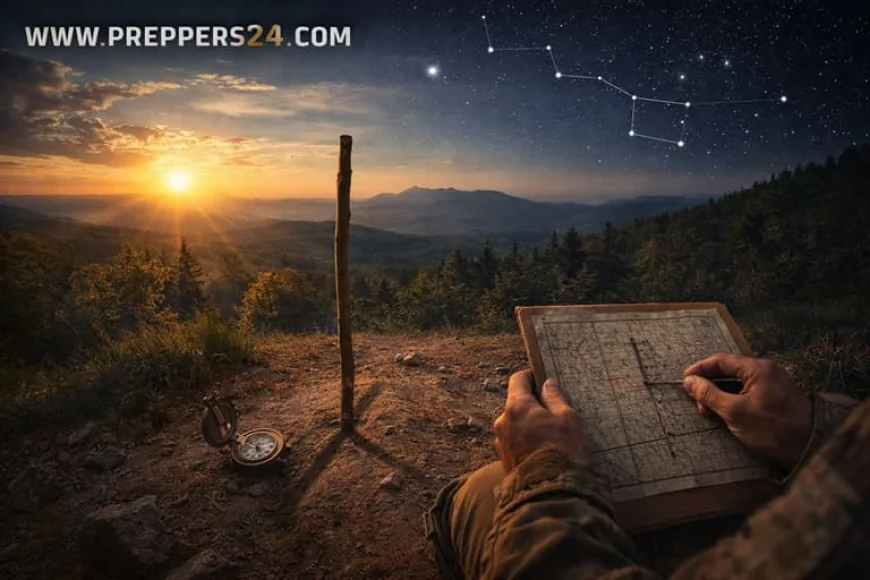
A simple shadow stick method allows rough orientation: place a straight stick vertically in the ground, mark the tip of the shadow, wait 15–20 minutes, mark again. The line between points runs approximately west to east.
Accuracy improves with patience, not movement.
Night Navigation Using the Stars
At night, celestial navigation becomes reliable. In the northern hemisphere, Polaris (the North Star) remains nearly fixed and indicates true north. Locating the Big Dipper and extending its outer bowl edge leads directly to Polaris.
In the southern hemisphere, the Southern Cross provides a similar reference by projecting its long axis toward the south celestial pole.
Cloud cover makes stars unreliable—never base your plan on a single method.
Vegetation and Environmental Indicators
Natural indicators are secondary tools, not primary ones. Moss growth, tree branch density, and snow melt patterns can suggest direction, but they vary widely by environment.
Use these cues only to confirm, never to decide alone.
Sound, Wind, and Smell
Human activity produces sound long before it becomes visible. Distant roads, trains, or industrial noise can guide direction in otherwise featureless terrain.
Wind direction remains relatively stable over short periods and can be used to maintain consistent travel bearings.
Smell may sound absurd, but smoke, agriculture, and industry carry distinct scents—your nose is more useful than you think, even if it complains about it.
Movement Strategy: Precision Over Speed
Walking faster increases error accumulation. Travel in deliberate segments, using landmarks to maintain alignment. Stop frequently and reassess.
If lost, aim for known linear features—rivers, roads, power lines. Linear features simplify navigation by reducing directional uncertainty to two choices.
One Small Truth People Hate
Most navigation failures happen because people refuse to admit they are lost. Survival improves immediately after that admission.
Yes, even the guy who “knows a shortcut.”
Pro Tip – Survival Advice
Navigation depends on information access. In extended outages or off-grid situations, having reliable power for radios, maps, or emergency lighting changes everything. Many experienced preppers quietly integrate dependable portable power and solar solutions into their plans through trusted off-grid energy platforms, which keeps navigation tools functional when infrastructure disappears.
And no, yelling at the forest does not improve signal strength.
Final Thoughts
Navigation without tools is not magic. It is pattern recognition under pressure. Learn terrain behavior, understand celestial movement, and move with intention. When technology fails, systems remain.
Survival navigation rewards the calm observer, not the confident wanderer.