Outbreak Scenario: Rabies-Like Zombie Virus and the Dark History of Human Control Experiments.
A serious outbreak scenario analyzing neurotropic viruses, historical human experimentation, and the theoretical possibility of a behavior-altering epidemic.
 P24
P24
Rabies-Like Zombie Virus and the Dark History of Human Control Experiments
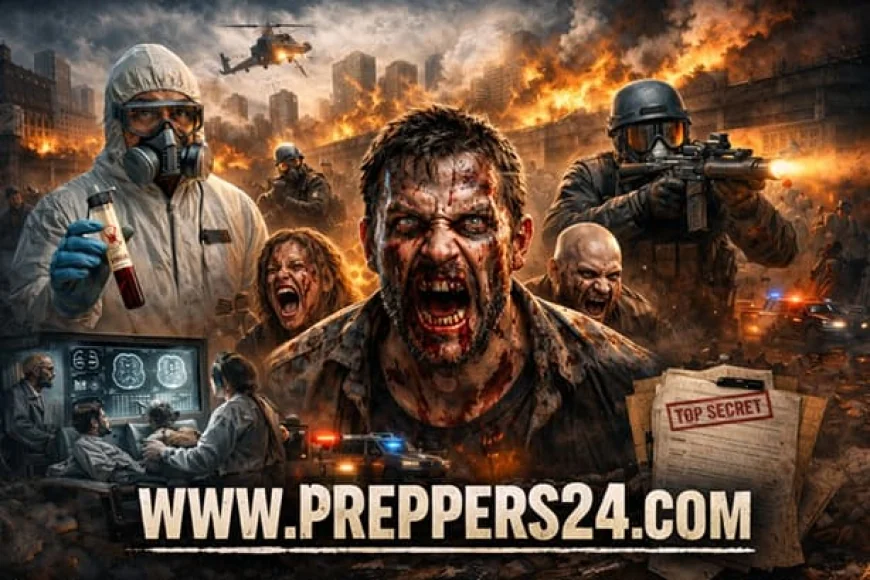
The idea of a “zombie virus” is usually dismissed as fiction. That dismissal is comforting—and potentially dangerous. Not because the dead could rise, but because human behavior can be profoundly altered by biological mechanisms that already exist.


This article explores a hypothetical outbreak scenario based on real neurotropic viruses, documented historical experimentation, and the uncomfortable reality that control of human behavior has been a long-standing scientific and military objective.
This is not fantasy. It is a convergence scenario.
Rabies: A Real Virus With Fictional Implications
Rabies is one of the most disturbing viruses known to medicine. It does not kill immediately. Instead, it:
-
attacks the central nervous system
-
induces aggression, paranoia, and hyperreactivity
-
suppresses pain perception
-
removes fear and self-preservation behaviors
In its late stages, infected individuals may bite, scream, convulse, and display extreme hostility. The virus does not resurrect the dead—but it creates behavior that resembles loss of humanity.
The key point: the behavioral template already exists in nature.
Neurotropic Viruses and Behavioral Control
Viruses that target the brain are not rare. Some alter mood, impulse control, sleep, and risk behavior. From a purely biological perspective, behavior is a modifiable variable.
A hypothetical engineered pathogen would not need to “reanimate” anyone. It would only need to:
-
preserve basic motor function
-
suppress higher cognitive processes
-
amplify aggression and compulsive behavior
At that point, the result would be indistinguishable from what popular culture calls a “zombie.”
The Dark Precedent: Nazi Human Experiments
Nazi Germany conducted extensive human experimentation under the guise of medical research. These experiments included:
-
neurological trauma studies
-
hypothermia and oxygen deprivation tests
-
attempts to push the human body beyond normal limits
While there is no credible evidence of successful “reanimation,” the ideological framework is important: humans were treated as biological material, not moral entities.
The objective was optimization, not ethics.
Soviet Experiments on Human Endurance and Control
The Soviet Union pursued research into:
-
extreme endurance
-
psychological breaking points
-
behavior under prolonged stress and deprivation
Declassified documents show a willingness to test limits of consciousness, pain tolerance, and obedience. Again, no confirmed resurrection programs—but a clear pattern of interest in controlling the human nervous system.
The question was never “can we bring the dead back?”
It was “how far can we push the living before they stop being themselves?”
American Programs: Mind Control and Behavioral Engineering
In the United States, Cold War–era programs explored:
-
chemical and biological influence on cognition
-
memory disruption
-
obedience and suggestibility
These programs were later acknowledged, partially declassified, and publicly condemned. But condemnation does not erase capability. It only marks a moment when exposure became unavoidable.
The research question was consistent across regimes:
Can human behavior be overridden?
The Convergence Scenario
A modern outbreak scenario does not require secret necromancy. It requires convergence:
-
a neurotropic virus with high transmission
-
delayed symptom onset
-
behavioral alteration rather than immediate lethality
Such a pathogen could spread before detection, overwhelm systems, and create mass behavioral collapse rather than mass death.
From the outside, society would appear to be falling apart.
From the inside, individuals would simply be losing themselves.
Why This Scenario Is Treated as Impossible
Labeling something “science fiction” is an effective defense mechanism. It allows institutions to avoid planning for low-probability, high-impact events.
But history shows that the most dangerous threats are the ones dismissed as unthinkable—until they are no longer theoretical.
Outbreak Reality vs. Zombie Myth
There would be no resurrection. No walking corpses.
There would be:
-
violent neurological illness
-
mass psychosis
-
breakdown of social behavior
-
loss of centralized control
The result would look apocalyptic—not because the dead returned, but because the living changed.
Final Thoughts
A “zombie outbreak” is not a literal threat. A behavior-destroying epidemic is.
History demonstrates that humans have repeatedly attempted to control minds, bodies, and behavior—often under crisis conditions, often without ethics, often in secrecy.
The most frightening scenario is not that such an outbreak is guaranteed.
It is that it is biologically conceivable, and therefore cannot be dismissed.
Preparedness begins where comfort ends.